
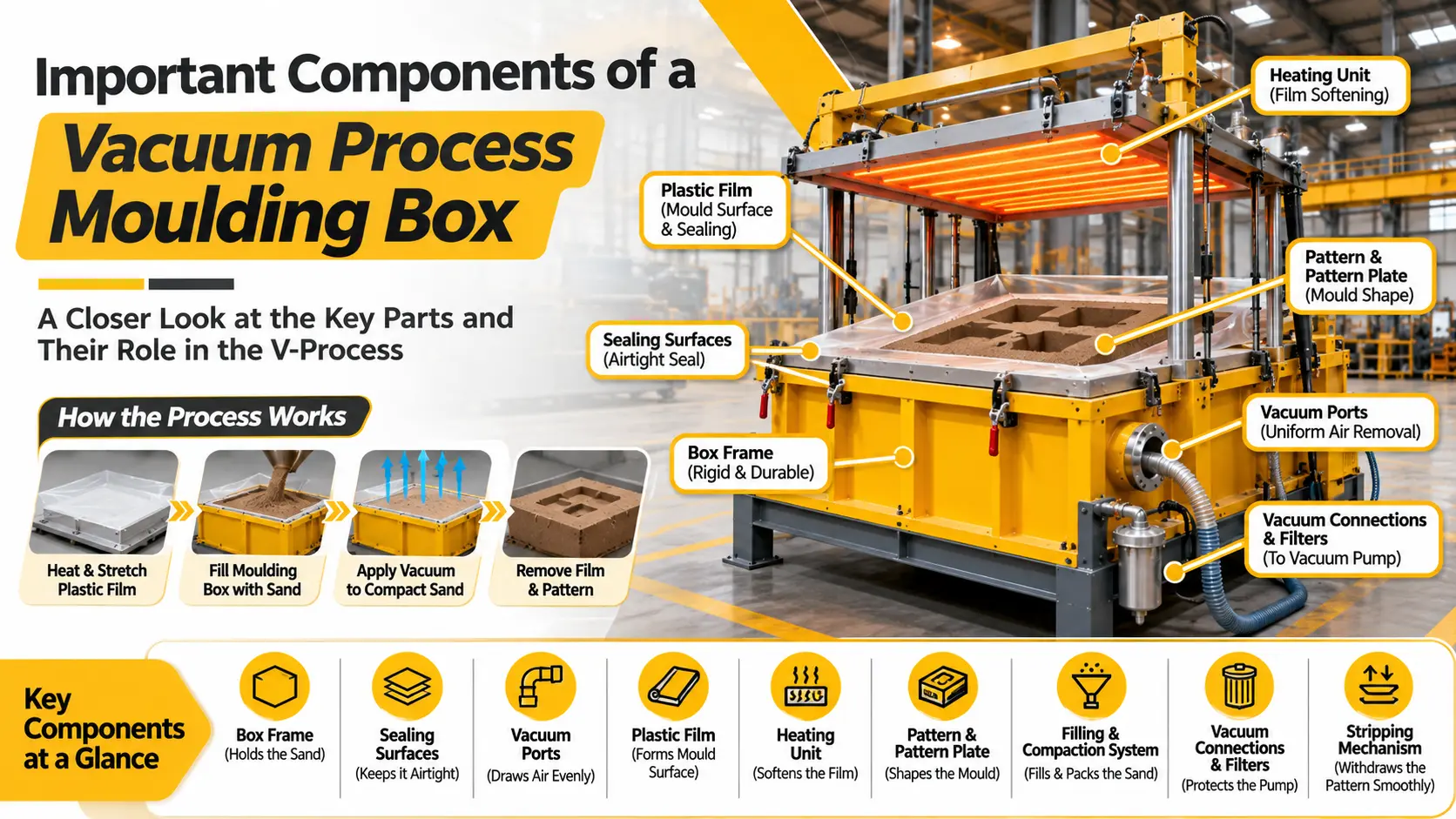
VPM, also known as the V-process, is used by foundries to produce high-quality castings with accurate dimensions while reducing the use of chemicals. The efficiency of vacuum process moulding depends on the design and condition of every component of the moulding box. Sealing problems and blockages in the vacuum port can disrupt production without giving any warning signs.
Understanding the components of a moulding box makes it easier to ask better questions when evaluating vacuum process moulding box manufacturers in India.
How the Process Works
A heated plastic film is stretched over the pattern and drawn tight against it. The moulding box is then positioned and filled with sand. A vacuum pump removes air from the box, and atmospheric pressure compacts the sand. Chemical bonding is not responsible for holding the sand together, so the sand can easily be removed after casting.
Key Components of the Moulding Box
- The box frame: It holds the sand and must stay rigid under vacuum and during handling. A flexing frame causes sealing problems and uneven mould walls.
- Sealing surfaces: These keep the film airtight against the box edges. Smooth, well-finished edges prevent leaks.
- Vacuum ports: Ports must draw air evenly through the sand. Uneven vacuum causes soft spots and sand collapse.
- The plastic film: It forms the mould surface and seals the sand. Thickness matters: too thick and it misses fine details, too thin and it can tear.
- The heating unit: It softens the film to the right temperature. Uneven heating leads to wrinkles and weak seals.
- The pattern and pattern plate: The pattern shapes the mould. Worn or misaligned patterns cause dimensional drift.
- The filling and compaction system: A hopper fills the box, and vibration packs the sand around the pattern.
- Vacuum connections and filters: Airtight lines carry vacuum to the box, and filters protect the pump from fine sand.
- The stripping mechanism: It withdraws the pattern smoothly so the mould edges stay intact.
Components Work as a Team
Each component of a vacuum process moulding box interacts with the others, and failure of any one of them can cause problems for the whole process. Even the most effective vacuum pump cannot compensate for leaks in the seals of the moulding box. Good film cannot keep its shape if the sand packing is done incorrectly. Poor sand filling leads to uneven vacuum distribution even if the other parts work properly.
Sometimes the reasons for casting defects are unexpected. For example, unevenness in a casting may lie not in the quality of the film, but in leaking seals. That is why it is important to select a supplier who understands how the whole moulding box works. Consider the compatibility of components and the technical support of the supplier before purchasing.
Choosing the Right Partner
While considering vacuum process moulding box manufacturers in India, there are some things other than cost to be considered. These include foundry expertise, certification, customisation and after-sales service.
J.K. Foundry is an ISO 9001:2015 certified company that has been offering foundry equipment since 1995. With a team that covers all these processes, customers get a single point of contact for their requirements.
Conclusion
The reliability of a vacuum process moulding box depends on its weakest part. Rigidity of the frame, good seals, proper vacuum distribution and consistent film all contribute to producing good castings. Knowing the components helps in choosing suppliers correctly, and it takes only a little time to evaluate each component at the beginning.
Plan Your Vacuum Moulding Box
Ready to plan a new box or upgrade an existing setup? Share your casting sizes, expected output and floor space with the J.K. Foundry team.
Get a Vacuum Process Moulding Box for Your Foundry
Share your casting sizes, expected output and floor space with our experts.